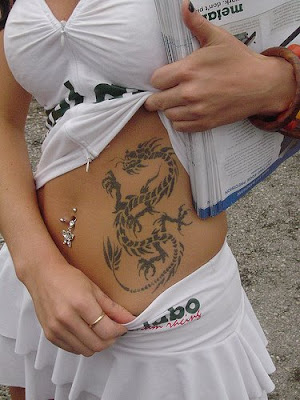


 The word "tattoo" comes from the Tahitian word / Tatu, which have the meaning signifies something. Tattoo or tattoos (English: tattoo) is a mark made by inserting pigment into the skin. In technical terms, rajah is micro-pigment implantation. Rajah can be made on human or animal skin. Rajah in humans is a form of body modification, temporary tattoo of animals commonly used as an identification.
 DO NOT be surprised if you get into the Dayak villages and meeting with old men adorned with a variety of beautiful tattoo on the several parts of his body. Tattoos that adorn their bodies are not just decoration, let alone to be considered heroes. However, tattoos for the Dayak community has a very deep meaning.
Tattoos for some ethnic communities are part of the Dayak traditions, religion, social status in society, as well as the appreciation could also interest on the ability of a person. Therefore, the tattoo can not be made arbitrarily.
There are certain rules in making a tattoo or Parung, good selection of pictures, the social structure of the tattooed and tattoo placement. Nevertheless, the religious tattoos have the same meaning in the Dayak community, namely as a "torch" in the journey towards natural person eternity, after death.
Therefore, more and more tattoos, "Torch" will be more bright and the road to the field of natural immortality. Nevertheless, still making a tattoo can not be made as much in vain, because it must comply with customs rules.
Every dayak sub tribe have different ways of tattoos.For the Dayak tribes who live on the border of Kalimantan and Sarawak of Malaysia, for example, a tattoo around the fingers indicates the person who likes to help the tribe as healers. More and more tattoo on his hand, shows that more and more people and getting expert help in treatment.
For the Dayak Kenyah and Kayan Dayak in East Kalimantan, the number of tattoos often depict the person is already wandering. Since each village has a tattoo of a different motive, many owners have visited the tattoo signifies many villages.
Do not imagine that the village has just a few miles. In Kalimantan, the distance can antarkampung hundreds or even thousands of kilometers, and must be taken by boat down the river more than a month!
Tattooing can also be given to the nobles. Among the Dayak Kenyah, a common motif for the nobility (paren) is a hornbill bird that is endemic to Borneo that are sacred.
As for the Dayak Iban, tattooed chieftain and his descendants with the motif of "world top" or something that lives in space. Besides the motive was chosen, how the tattoo workmanship for the nobility are usually more subtle and detailed than the tattoo for the middle class (panyen).
Bagi subsuku lainnya, pemberian tato dikaitkan dengan tradisi mengayau atau memenggal kepala musuh dalam suatu peperangan. Tradisi ini sudah puluhan tahun tidak dilakukan lagi, namun dulunya semakin banyak mengayau, motif tatonya pun semakin khas dan istimewa.
Tato untuk sang pemberani di medan perang ini, biasanya ditempatkan di pundak kanan. Namun pada subsuku lainnya, ditempatkan di lengan kiri jika keberaniannya "biasa", dan di lengan kanan jika keberanian dan keperkasaannya di medan pertempuran sangat luar biasa.
"Pemberian tato yang dikaitkan dengan mengayau ini, dulunya sebagai bentuk penghargaan dan penghormatan suku kepada orang-orang yang perkasa dan banyak berjasa," tutur Simon Devung, seorang ahli Dayak dari Central for Social Forestry (CSF) Universitas Mulawarman Samarinda.
TATO atau parung atau betik tidak hanya dilakukan bagi kaum laki-laki, tetapi juga kaum perempuan. Untuk laki-laki, tato bisa dibuat di bagian mana pun pada tubuhnya, sedangkan pada perempuan biasanya hanya pada kaki dan tangan.
Jika pada laki-laki pemberian tato dikaitkan dengan penghargaan atau penghormatan, pada perempuan pembuatan tato lebih bermotif religius.
"Pembuatan tato pada tangan dan kaki dipercaya bisa terhindar dari pengaruh roh-roh jahat dan selalu berada dalam lindungan Yang Maha Kuasa," ujar Yacobus Bayau Lung.
"Making a tattoo on the hands and feet can reliably protected from the influence of evil spirits and is always in the shelter of the Almighty," said Yacobus Bayau Lung.
In particular subsuku, making tattoos are also associated with self-esteem of women, and became known tedak term wealth, which means women are not tattooed are considered lesser than the tattooed. However, such a view is valid only in small part subsuku Dayak.
In the Dayak Kayan, there are three kinds of tattoos are usually in female clothing, among others tedak gauze, which covers the entire foot and used as an adult. Tedak usuu, tattoos are made on the whole hand and thigh tedak hapii at all.
While the tribe Dayak Kenyah, making tattoos on women starting at age 16 years or after the first menstruation. For the manufacture of tattoo for women, made with traditional ceremonies in a special home. During the making of tattoos, all men are not allowed to leave the house. Besides the whole family is also required to undergo a variety of restrictions to avoid a disaster for women who are tattooed or her family.
Motif tattoos for women is more limited as the image of black nails around knuckles song called irang or bamboo shoots. As for the finger across the back of the book is called Cor. Tattoos on the wrist pictorial called silong lejau tiger face.
There is also a tattoo made in the thigh. For Dayak women have tattoos in thigh high social status and are usually equipped with a bracelet at the lower calf.
Motif tattoo on the thigh is usually also resembles silong lejau. The difference with a tattoo on his hand, there are transverse lines in the calf, called nang klinge.
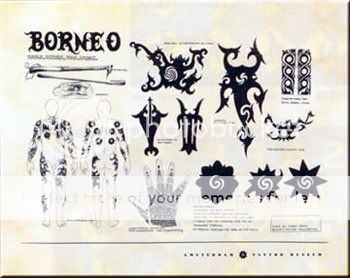 Model Tato Borneo
Tato sangat jarang ditemukan di bagian lutut. Meski demikian ada juga tato di bagian lutut pada lelaki dan perempuan yang biasanya dibuat pada bagian akhir pembuatan tato di badan. Tato yang dibuat di atas lutut dan melingkar hingga ke betis menyerupai ular, sebenarnya anjing jadi-jadian atau disebut tuang buvong asu.
Baik tato pada lelaki maupun perempuan, secara tradisional dibuat menggunakan duri buah jeruk yang panjang dan lambat-laun kemudian menggunakan beberapa buah jarum sekaligus. Yang tidak berubah adalah bahan pembuatan tato yang biasanya menggunakan jelaga dari periuk yang berwarna hitam.
"Karena itu, tato yang dibuat warna-warni, ada hijau, kuning dan merah, pastilah bukan tato tradisional yang mengandung makna filososfis yang tinggi," ucap Yacobus Bayau Lung.
Tato warna-warni yang dibuat kalangan pemuda kini, hanyalah tato hiasan yang tidak memiliki makna apa-apa. Gambar dan penempatan dilakukan sembarangan dan asal-asalan. Tato seperti itu sama sekali tidak memiliki nilai religius dan penghargaan, tetapi cuma sekadar untuk keindahan, dan bahkan ada yang ingin dianggap sebagai jagoan.
Effect of Tattoos
Although many claim tattoos and piercings on his body as an artistic expression, can also be the threat of danger if the skipper doing tattoos and piercings everywhere. According to health institutions, the danger tattooed anywhere including chronic infection, prolonged bleeding, skin defects, hepatitis B and C, tetanus, HIV (despite the case not been documented), skin allergies, abscesses or boils, a permanent hole the eyebrow or nose, cracked or broken teeth, swallowing the jewelry is accidentally installed on the tongue, and speaking disorders.
Use non-sterile tattoo needles, the danger is greater. In addition to the above diseases can be contagious, infection can occur. Skin's surface naturally contain bacteria which are not the problem, if the skin in normal conditions, but after the tattoo, the skin that allow bacteria into the wound, the bacteria can enter and at risk of infection arises. However, normal skin can heal properly, if you notice things the following basic, clean wash hands before touching or washing the skin where the tattoo is located, choosing high-quality aftercare product, do not use aftercare products with others. Last try to be more responsible to ourselves for the problems of hygiene and sanitation.







No comments:
Post a Comment